
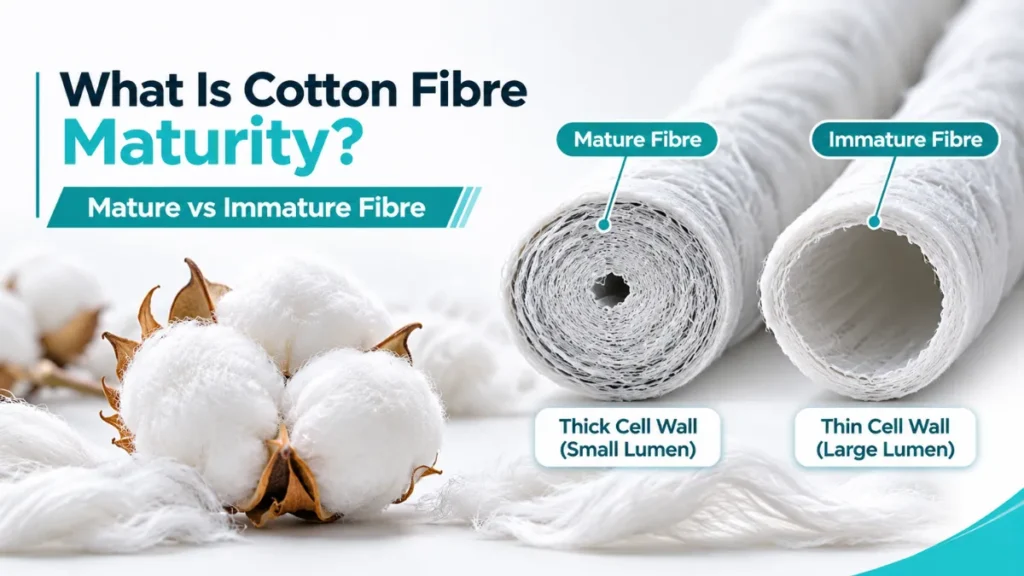
Quick answer: Cotton fibre maturity tells you how much a fibre’s wall has thickened compared with its width. A mature fibre has a thick wall and a small hollow centre. An immature fibre has a thin wall and a large one. Labs score it as a maturity ratio, and most treat about 0.85 or higher as mature. Immature fibre weakens yarn, tangles into neps and leaves white specks on dyed fabric.
A bale can test fine on length and strength and still ruin a dye lot. The dyed fabric comes back with tiny white flecks, and maturity is usually the culprit, because a basic HVI report does not show how much immature fibre the bale holds. So this guide covers what maturity means, how labs score it, what causes it in the field and what to ask for when you buy.
Mature vs immature vs dead fibre at a glance
Fibres on one seed never mature equally, so every bale holds a mix. Here is how the three types behave.
| Feature | Mature | Immature | Dead |
| Wall and hollow centre | Thick wall, small hollow centre | Thin wall, large hollow centre | Barely any wall |
| Typical score | Maturity ratio about 0.85 or higher | Maturity ratio about 0.75 to 0.85 | Theta under 0.25 |
| In spinning | Spins well and resists breaking | Breaks easily and forms neps | Brittle and hard to spin |
| In dyeing | Takes dye evenly | Takes less dye | Resists dye and shows as white specks |
Our guide to the cross section of cotton fibre shows how each type looks under a microscope.
What does cotton fibre maturity mean?
Maturity does not describe age. It describes how far the fibre wall thickened compared with the fibre’s size, a definition Thibodeaux and Rajasekaran use in the Journal of Cotton Science. A wall only counts as thick when you measure it against the fibre around it. We cover fibre maturity here, while crop maturity, meaning the days from sowing to boll opening, is a separate farming topic.
Theta, maturity ratio and IFC: the numbers on a lab report
Lab reports use four terms that sound alike. This table shows what each one tells you.
| Term | What it tells you |
| Theta | Wall area divided by the area of a circle with the same perimeter, on a scale of 0 to 1 |
| Maturity ratio (MR) | Theta divided by 0.577, a reference value from Pierce and Lord’s 1939 work |
| Percent maturity | The share of fibres that count as mature |
| Immature fibre content (IFC) | The share of fibres with theta below 0.25 |
Take a sample with an average theta of 0.52. Divide by 0.577 and you get a maturity ratio of 0.90, which counts as mature on most scales. Averages still hide a lot, though, because two samples can share the same mean maturity while one carries far more thin fibres. That’s why buyers who care about dyeing ask for IFC next to the average.
Why labs disagree on where “mature” starts
Search this topic and you will find three different cut-offs. Research papers call a maturity ratio of 0.8 to 1.0 mature. A USTER reference table that Fibre2Fashion reprinted starts “mature” at 0.86 and calls anything under 0.75 very immature. Theta cut-offs for “mature” range from 0.50 to 0.70 across studies.
Each source is right for its own method, and three things move the line:
- The instrument. AFIS tends to report higher mean maturity than cross-section analysis, according to a 2015 Beltwide comparison.
- The averaging method. In one small USDA-ARS test set, maturity ratio by area ran about 8% higher than by number, and by weight about 14% higher (Cui and colleagues).
- The variety. Varieties differ in fibre width, which shifts the numbers.
Compare maturity figures only when they come from the same method.
How a fibre becomes mature
A cotton fibre grows in three stages: it stretches in length, thickens its wall with cellulose, and then dries and twists once the boll opens (Cotton Physiology Today). Cells start at different times, which is why one bale always carries a mix, and our guide to the difference between lint and fuzz in cotton shows how the early starters become lint.
Weather and timing squeeze the middle stage. Lengthening has an optimum temperature about 10°F (roughly 5 to 6°C) colder than thickening, so a cool spell can slow wall building while fibres keep growing longer. Once the leaves drop, fibre development may continue for only 2 to 3 days.
What makes fibre immature?
In north India, bolls that set late often finish thickening as November nights turn cool, and classing researchers flag cool weather as one of the main causes. Australian classing guidance and field research point to these usual culprits:
- Cool temperatures during wall development slow the thickening.
- Early frost, hail or disease end the season before bolls finish.
- Defoliating before about 60% of bolls open opens immature bolls, lowers maturity and raises neps.
- Potassium shortage, too much nitrogen or irrigation, dense stands and heavy boll load each link to low micronaire, a sign of underdeveloped fibre.
- Seed position matters too, because seeds near the tip of a lock carry thinner-walled fibre than seeds near the base.
You control some of these and not others. If you use harvest aids, trials at the Australian Cotton Research Institute found that applying them before about 60% of bolls open lowered maturity and raised neps. If you hand-pick, as most growers in Haryana, Punjab and Rajasthan do, the same logic applies: pick fully opened bolls. Our lint percentage and ginning outturn guide lists boll maturity and picking time among the factors that move your outturn.
What immature fibre does to yarn and fabric
In the spinning mill, thin-walled fibres break easily, so mills see more breakages, short fibre and waste (USTER). The loose fibres then tangle into neps, which are tiny knots, and one often-cited figure from 1988 says more than 90% of neps in finished fabric contain immature fibre.
White specks give the problem away at the dye house. Thin walls pick up less dye, so neps stay pale, especially on dark shades. You cannot see them until you dye the fabric, and by then the fault already sits in the cloth. Chemists have known since 1848 that dead fibres resist dye. Our guide on what kind of fibre cotton is adds that buyers sometimes blame a bad dye lot when mixed maturity is the real cause.
Mills can fight back in two ways. Combing cuts white specks, while carding alone can open the fibres up and spread the problem (Beltwide study). Mercerising before dyeing helps level the colour. One estimate splits white-speck neps roughly 30% to variety, 30% to growing conditions and 40% to processing (Bel and Xu), so growers and mills each own part of the fix.
How labs measure maturity
No single test tells the whole story, and labs mix methods.
| Method | What it does | Good to know |
| Cross-section image analysis | Measures wall area and perimeter on 300 to 500 cut fibres | The reference method, but slow (study) |
| Differential dyeing | Turns mature fibres red and immature fibres green (USDA-ARS) | A quick visual check |
| Micronaire on HVI | Pushes air through a compressed plug of fibre | Fast, but it blends fineness and maturity |
| AFIS | Tests single fibres with optical sensors and reports maturity ratio and IFC | Mills use it for process control |
| Cottonscope | Photographs fibre snippets in water under polarised light | Quick, and ASTM D8394 covers it |
| NIR and FT-IR | Reads the fibre’s spectrum | Researchers mostly use it |
Our cross section guide explains how labs embed and slice fibres for cross-section analysis.
Micronaire is not maturity
Everyone quotes micronaire, and many people read it as maturity. It is not. Micronaire blends fineness and maturity, which means coarse immature cotton and fine mature cotton can show the same reading. HVI does not measure immature fibre content directly, according to a Journal of Cotton Science study. Our cotton fibre quality parameters guide lists the micronaire bands, and 3.7 to 4.2 counts as premium.
So when you buy lint from a ginner or trader in India, treat micronaire as a starting point. Then use this USTER rule of thumb for short and medium staple raw cotton.
| Maturity ratio | Reading | IFC |
| Below 0.75 | Very immature | Above 15% |
| 0.76 to 0.85 | Immature | 12 to 14% |
| 0.86 to 0.90 | Mature | 9 to 11% |
| 0.91 to 0.95 | Mature | 6 to 8% |
| Above 0.96 | Very mature | Below 6% |
Treat it as a guide, not a standard. Ask your supplier for three numbers: micronaire, maturity ratio and IFC. If the report only has micronaire, send a sample to a lab that runs AFIS.
Why maturity matters for absorbent cotton and linters
Moirai Cotton Pulp Pvt. Ltd. has made cotton linter pulp and bleached surgical cotton since 2019, working from Hisar in Haryana’s cotton-growing region. Our guide to cotton for medical use explains that short-staple, high-micronaire cotton generally works best for absorbent cotton. Australian classing guidance adds that a micronaire below 3.5 can mean fine, possibly immature lint, which makes a high reading a good first sign. Maturity then confirms it.
If you buy in bulk, our bleached surgical cotton page lists full specifications. If you need cellulose raw material, see our cotton linter pulp page.
FAQ
What is the maturity ratio of cotton?
It is theta divided by 0.577. Values near 1 mean a well-thickened wall, and many mills treat about 0.85 or higher as mature.
What is the difference between mature and immature cotton fibre?
Mature fibre has a thick wall and a small hollow centre. Immature fibre has a thin wall and a large one, and it breaks more easily and dyes unevenly.
What is a dead cotton fibre?
A dead fibre has almost no secondary wall. It looks like a thin, nearly transparent ribbon, resists dye and shows up as a white speck.
Is micronaire a measure of maturity?
Only partly. Micronaire blends fineness and maturity, so ask for maturity ratio and IFC as well.
How can you reduce immature fibre?
Pick fully opened bolls, delay harvest aids until about 60% of bolls open and watch nutrient and water balance. At the mill, combing removes much of the thin fibre.

