
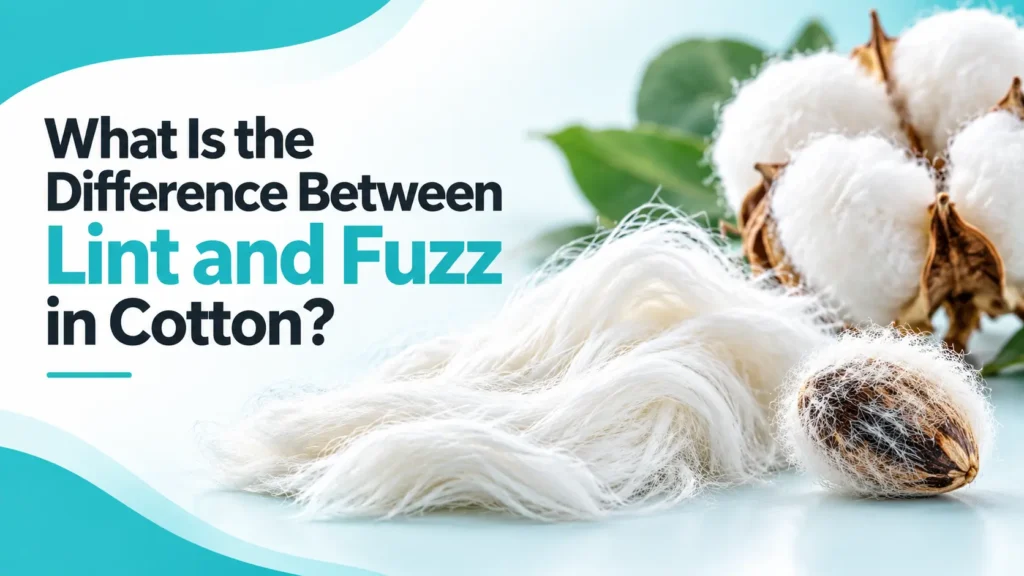
Quick answer:- Lint is the long, spinnable fibre that a gin pulls off the cotton seed. Fuzz is the short fibre that clings to the seed afterward. Lint runs about 1 to 5 cm, while fuzz measures only a few millimetres. Mills spin lint into yarn, and processors turn fuzz into pulp and cellulose once a delinting machine removes it. At that point, the trade calls it linters.
Lint vs fuzz at a glance
| Feature | Lint | Fuzz |
| Length | About 1 to 5 cm | A few millimetres, varies by cut |
| Grows from | Seed coat | Seed coat |
| After ginning | Goes to the baling press | Stays on the seed |
| Removed by | Gin | Delinting machine |
| Trade name | Cotton lint | Cotton linters |
| Main use | Yarn and fabric | Pulp, cellulose, specialty paper |
| HS code | 5201 | 1404 20 |
Lint, fuzz and linters: what each word means
Writers use these words loosely, so here is what each one means.
| Term | What it means |
| Lint | The long staple fibre removed at ginning |
| Fuzz | The short fibre left on the seed (the botanical term) |
| Linters | Fuzz after a delinting machine strips it off (the trade term) |
| Fuzzy seed | A seed that still wears its fuzz |
| Lint percentage | Lint weight as a share of seed cotton weight |
| Lint index | Weight of lint on 100 seeds |
Also, “lint” means something else in daily life. Dryer lint and wound dressings have nothing to do with the cotton fibre we cover here.
What is cotton lint?
Raw cotton lint is the fibre you see packed in a bale. Each strand is a single long cell that grew out of the seed coat. Mills pay for lint because it spins well, and staple length sets much of its price.
At the gin, cotton lint and seed arrive together as seed cotton, which Indian growers call kapas. The gin separates them, and the lint heads to the press. Our guide to cotton fibre quality parameters explains length, strength and micronaire.
What is fuzz in cotton?
Fuzz is the short fibre that survives ginning. The gin takes the long lint but leaves a fine coat on the seed, and that coated seed is a fuzzy seed.
Fuzz also causes real problems. It creates friction and lint loss inside the gin, and it raises ginning energy. It also hinders germination, so growers often delint seed before they plant it.
After a delinting machine removes the fuzz, you have linters. Our article on cotton linters covers their types, grades and uses, and our page on quality cotton linters shows the products.
How lint and fuzz form on the seed
Both fibres start as single cells on the seed coat. Scientists call them epidermal cells, and each one stretches into a hair. Our guide on the structure of a cotton fibre shows that hair layer by layer.
Some of these cells start growing around the time the flower opens. They have the longest to grow, so they become lint. A second wave of cells starts a few days later. They get less time to elongate, so they stay short and become fuzz. Many other cells never grow a fibre at all. Lint and fuzz come from the same kind of cell, but lint starts first and keeps growing longer.
How ginning separates them
Here is the flow:
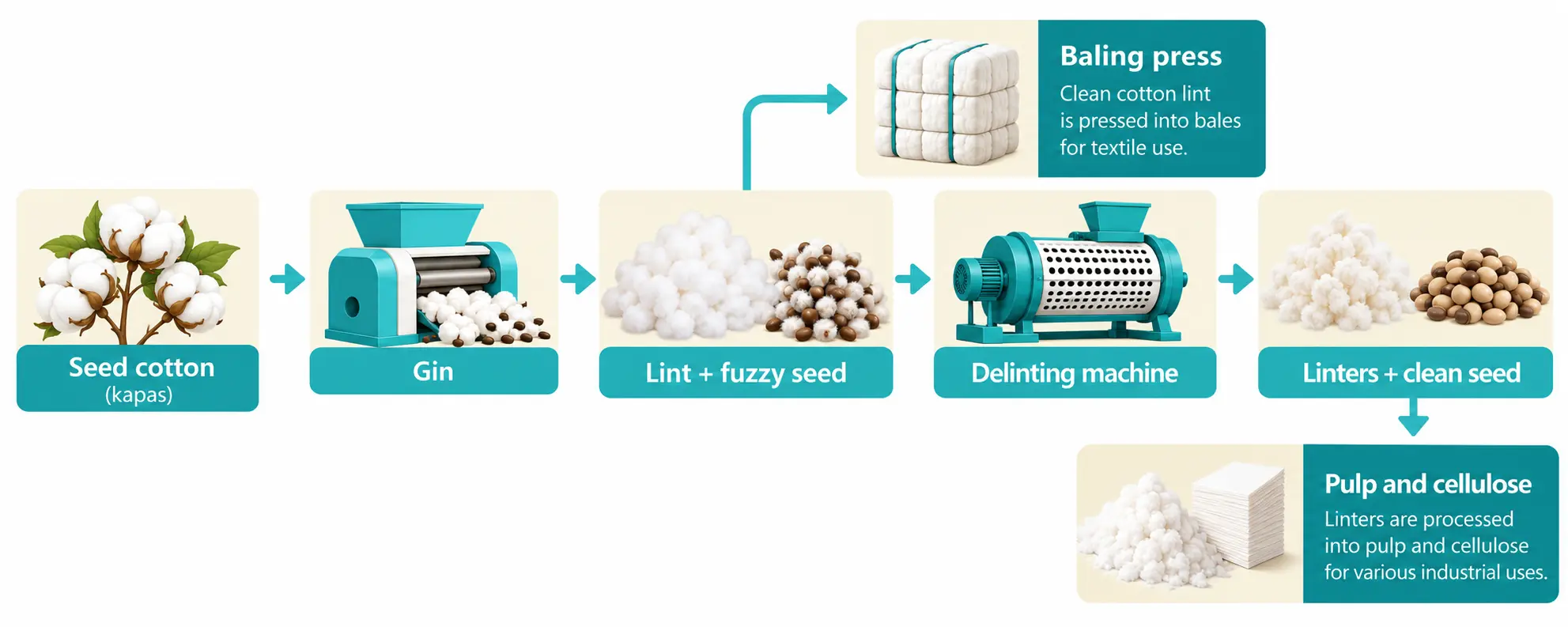
First, a saw gin pulls the lint off the seed. Next, the fuzzy seed moves to a delinting machine, which strips the fuzz in one or more passes. Processors call each pass a cut. The first cut takes the longer fibres, and later cuts take shorter ones with more seed bits mixed in.
Impurities rise from the first cut to the third, so purity drops with every pass.
Lint percentage, lint index and lint ratio
These three terms sound alike, but each one measures something different.
Percentage of lint (also called the cotton lint ratio or ginning outturn) tells you how much of the seed cotton becomes lint:
Lint % = lint weight ÷ seed cotton weight × 100
Index of lint tells you how much lint sits on 100 seeds. It uses the seed index, which is the weight of 100 seeds with the fuzz still on:
Lints index = seed index × lint % ÷ (100 − lint %)
Take 100 kg of kapas that gives 35 kg of lint. Your lint percentage is 35. Now say your seed index is 10 g. Then:
10 × 35 ÷ 65 = about 5.4 g
So 100 seeds carry about 5.4 g of lint. Just remember to weigh the seeds with the fuzz on, or your result will drift.
Lint vs linters: HS codes
Traders file the two fibres under different headings, so the difference shows up on invoices too.
| Product | HS code |
| Cotton, not carded or combed (lint) | 5201 |
| Cotton linters | 1404 20 |
| Cotton linters pulp | 4706 10 |
The World Customs Organization notes that fibres under heading 5201 run 1 to 5 cm, while linters are usually under 5 mm. India adds its own eight-digit codes under 5201, so check our cotton lint HSN code page for the exact tariff line.
Why do sources give different lengths for fuzz?
Search this topic and you will see fuzz listed at under 5 mm, 5 to 6 mm, 1.5 to 6 mm and even up to 12 mm. Lint shows a spread too, anywhere from 1 to 5 cm. Nobody is wrong. Lint is a spinnable staple, so its length depends on the variety. Fuzz length also depends on the variety, and it changes with the cut. First-cut linters run longer than later cuts. Treat any single figure as the range for one cotton or one grade, not as a rule.
Are lint and fuzz chemically different?
Barely, Both are mostly alpha cellulose, and one study found their crystalline fractions almost identical. So, why do linters look less pure? Impurities. Seed bits and dirt ride along with the fuzz, and they increase from the first cut to the third. The fibre stays the same. The cleanliness changes.
Why the difference matters
The difference shows up in three places:
- Ginners lose lint and burn extra energy fighting fuzz.
- Farmers often delint seed so it germinates better.
- Buyers send lint to spinning mills and linters to pulp makers.
Processors purify linters into chemical cotton, which feeds nitrocellulose, specialty paper and medical absorbent cotton. You can follow that path on our cotton linter pulp page or read how linters become pulp.
FAQ
Is fuzz the same as lint in cotton?
No. Both grow from the seed coat, but lint is long and spinnable, while fuzz is short and stays on the seed after ginning.
Are linters and fuzz the same thing?
Nearly. Fuzz is the botanical term, and linters is the trade term for fuzz after a delinting machine removes it.
Is fuzz chemically different from lint?
Barely. Both are mostly alpha cellulose. Impurities, not the fibre itself, make linters look less pure.
What does lint percentage tell you?
It shows how much of your seed cotton turns into lint. Use the formula above to calculate it for your own lots.
Why do cotton seeds look fuzzy after ginning?
The gin removes the long lint but leaves the short fibres rooted in the seed coat. That layer is fuzz, and a delinting machine strips it off later.

