
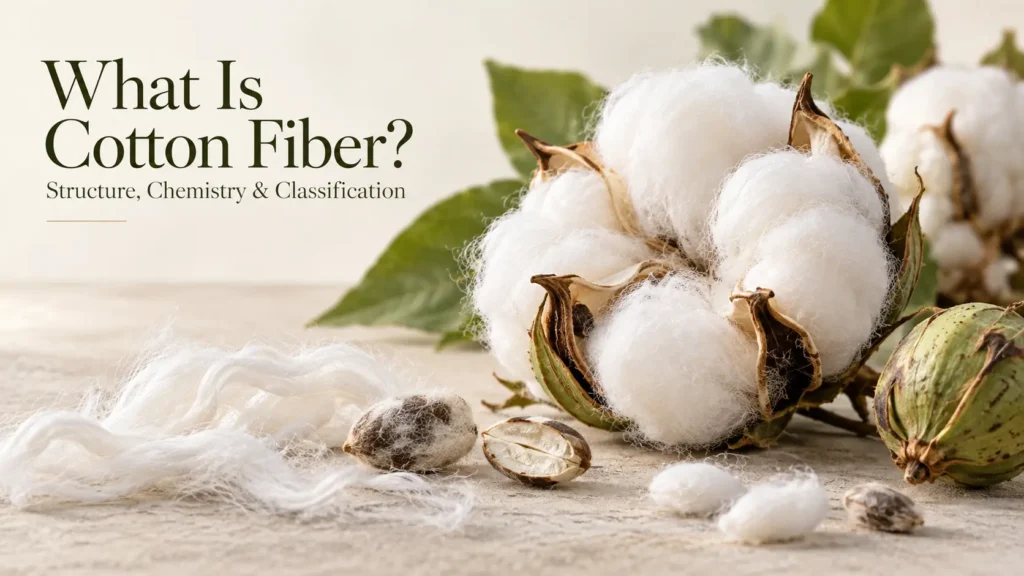
Quick answer: Cotton is a natural, plant-based seed fiber made primarily of cellulose. It isn’t a protein fiber, and it isn’t a bast fiber either: it grows directly from the cottonseed rather than from the plant’s stem.
This guide covers cotton’s chemistry and fiber structure. For staple length grading and variety comparisons (Upland, Pima, Egyptian), our types of cotton guide goes deeper on that side of things.
What Is Cotton Fiber?
Cotton grows as a hair-like strand on the surface of the cottonseed, inside the boll. Botanists classify this as a seed hair fiber. Kapok is the only other fiber that develops this way, but it’s too weak and short to spin into usable yarn.
Because cotton comes from a plant, it’s a natural fiber. More specifically, it’s a cellulosic fiber, since cellulose makes up the bulk of its structure.
Cotton is also a staple fiber, not a filament fiber, and that distinction does real work downstream. Staple fibers are short, measured in millimeters or inches, while filament fibers like silk or polyester run continuously. Filament yarns get their strength from unbroken length; staple yarns get it from how well individual fibers grip each other when twisted together, which is exactly why cotton’s length and its surface texture (more on that below) both end up mattering so much to spinners.
Cotton’s Place in Natural-Fiber Classification
Cotton sits in the cellulosic seed fiber family. It develops as a single elongated cell on the cottonseed’s surface inside the boll, which is what separates it from bast fibers like flax and jute, extracted from plant stems instead of seeds.
| Property | Cotton |
| Natural or synthetic | Natural |
| Chemical class | Cellulosic |
| Botanical origin | Seed surface |
| Fiber form | Staple |
| Protein or bast fiber? | Neither |
Chemical Composition
After scouring and bleaching, cotton fiber is close to pure cellulose, commonly cited around 99%.1 The small remainder includes natural moisture, wax, pectin, and residual protoplasm from the living plant cell. The wax coats the fiber surface; the pectin binds plant cell material together.
Cellulose itself is a chain of linked glucose molecules: two glucose units form a cellobiose unit, and thousands of these link end-to-end into a single cellulose fiber. Textile scientists measure this chain length using the degree of polymerization (DP). Cotton-derived cellulose has a degree of polymerization of roughly 9,000 to 15,000, notably higher than wood-derived cellulose.2 That unusually long chain is a major contributor to cotton’s tensile strength relative to its softness.
Cotton’s moisture regain, meaning how much moisture a bone-dry sample reabsorbs from ambient air, is commercially listed at around 7 to 8.5% depending on processing state (raw, dyed, or mercerized).3 In practice, this number matters more to spinners and dyers than to end consumers: mills condition cotton to a target regain before weighing and pricing it, since a bale’s commercial weight shifts with humidity even though nobody’s added or removed fiber.
Cotton Under the Microscope
Seen under magnification, cotton fiber doesn’t look like a smooth cylinder. It looks like a flat, twisted ribbon. That twist is called a convolution, and it forms as the boll opens and the fiber dries: the fiber collapses and twists along its length, and those twists let individual fibers interlock with each other during spinning. Without convolutions, cotton fibers wouldn’t grip well enough to form stable yarn.
In cross-section, a mature cotton fiber has four layers:
- Cuticle: thin outer protective coating
- Primary cell wall: the first structural layer beneath the cuticle
- Secondary cell wall: a thicker cellulose layer that provides most of the fiber’s strength
- Lumen: a hollow central channel
A fully mature fiber has a thick secondary wall and a small lumen. Immature fibers are thinner, more collapsed, and closer to flat-ribbon all the way through, which is also why they process and dye differently than mature fiber. Buyers sometimes attribute uneven dye uptake to a bad dye lot when the real cause is a mix of maturity levels in the same batch of raw cotton.
Length and Strength: How Cotton Fiber Is Graded
Two properties determine how fine and durable the resulting yarn can be:
- Staple length: the fiber’s length
- Tenacity: the fiber’s strength
Because cotton is a staple fiber rather than a continuous filament, every batch has to be measured and graded before spinning. Mills classify raw cotton against staple bands ranging from short-staple to extra-long-staple varieties like Pima and Suvin.
Length gets most of the attention in marketing copy, but consistency across a lot (how uniform the fiber length is, not just the average) tends to matter more to a spinning mill’s output quality than the headline staple number. We cover the full staple-length and micronaire grading system, uniformity index included, in the types of cotton guide.
Organic Cotton vs. Conventional Cotton
Organic cotton isn’t a different species or a different fiber structure. It’s a different growing method. Both are chemically the same cellulose fiber and convolute identically under a microscope.
| Organic | Conventional | |
| Pesticides | No synthetic pesticides | Synthetic pesticides used |
| Fertilizer | Natural only | Synthetic inputs allowed |
| Pest control | Crop rotation, natural methods | Chemical management |
The real differences between the two show up in farming impact: water use, soil health, pesticide exposure, not in the fiber itself. This is the point that trips people up most often, and it’s why a fabric labeled “organic cotton” isn’t chemically different or inherently softer than a conventional one; any difference in feel usually traces back to finishing, not fiber origin.
This isn’t the same distinction as Bt cotton, a genetically modified variety bred for pest resistance. Organic-vs-conventional and GM-vs-non-GM are two unrelated classifications, not opposites of each other.
Where Cotton Fiber Comes From
Cotton fiber grows on the cottonseed, inside the boll. Once the boll matures and splits open, the fibers are ready for harvest. What happens after harvest, including ginning, separating lint from seed, and the shorter linters left behind, is walked through in full in the types of cotton guide.
FAQ
Is cotton biodegradable?
Yes. As a natural cellulose fiber, it breaks down in the environment, unlike synthetic fibers such as polyester or nylon.
What’s the difference between cotton fiber and cotton linters?
Fiber (lint) is the longer strand spun into yarn. Linters are the short fuzz left on the seed after ginning, used in products like absorbent cotton rather than textiles.
Does organic cotton behave differently in fabric?
Not chemically: same cellulose, same strength profile. Any handfeel or performance differences reported anecdotally are more likely tied to processing and finishing than to the raw fiber itself.
Why do two cotton fabrics with the same fiber content feel so different?
Fiber chemistry is only part of the story. Yarn twist, weave or knit structure, and finishing treatments account for most of the handfeel difference between fabrics that are otherwise both 100% cotton.
Sources
- Cotton Incorporated, Cotton for Nonwovens Technical Guide – cottoninc.com/?p=802
- Fiber & Biopolymer Research Institute, Texas Tech University, “Cotton Cellulose: Perfect Precursor for Bioproducts Development,” ASA/CSSA/SSSA Annual Meeting, 2016 – scisoc.confex.com/crops/2016am/webprogram/Paper99699.html
- ASTM D1909, Standard Table of Commercial Moisture Regains for Textile Fibers – store.astm.org/d1909-13.html

