
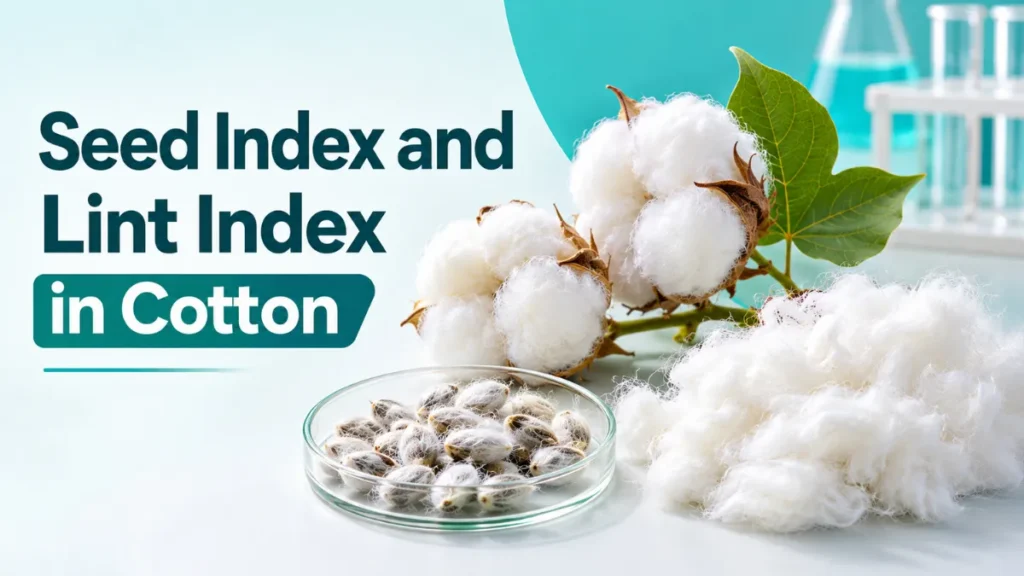
Quick Answer: Seed index is the weight of 100 fuzzy cotton seeds, in grams. Lint index is the weight of the lint those 100 seeds carry. One formula links the two to your lint percentage, so you can work out either number from the other two.
This matters because two varieties can post the same ginning out turn (GOT) yet carry very different amounts of fibre per seed. GOT hides that gap, but the lint index shows it. Cotton is a seed hair fibre, so every gram of lint grows on a seed, and the seed deserves as much attention as the fibre.
This guide gives you the definitions, the formulas and a worked example that uses real Indian trial data. You will learn which number to trust when two lab reports disagree.
What is the seed index in cotton?
Seed index is the weight, in grams, of 100 cotton seeds. Most labs weigh the seeds with the fuzz still on, so the number includes the short fibres that stay behind after ginning. Our lint vs fuzz guide shows the fuzz that stays on the seed and explains why a gin leaves it there.
Check the weighing basis before you compare any two reports. Texas A&M and Arkansas researchers weigh fuzzy seed. An ICAR trial across Indian centres weighed acid-delinted seed instead. The two methods give different numbers, so read the methods line first.
Species moves the number. In a trial at Faridkot, Ludhiana, Sirsa and Hisar, seven desi (Gossypium arboreum) genotypes averaged a seed index of 5.18 g. Arkansas breeders, who work with upland cotton, report a mean of 10.17 g across 6,453 lines. That gap is huge, so always name the species when you quote a figure.
Some papers say cotton seed index. It means the same thing as seed index in cotton.
What is the lint index in cotton?
Lint index is the weight, in grams, of the lint that 100 seeds carry. You never weigh it directly. Instead, you calculate it from your lint percentage and seed index, or from a raw ginning sample.
So what does it tell you? It shows how much fibre each seed grows. A variety with a high cotton lint index loads more lint onto every seed. Two things move that number: how many fibres cover the seed and how heavy each fibre is. Heavier fibres usually come from a greater thickness of the fibre wall.
Seed size plays a part. Bourland’s work on Arkansas breeding lines shows that selecting for a higher lint index tends to produce larger seeds. Larger seeds, in turn, tend to come with a lower lint percentage. Breeders balance the two.
Seed index and lint index formula in cotton
You need two inputs: seed index in grams and lint percentage.
Do you have raw sample weights? Use this route.
To find the number of seeds, divide the seed weight by the weight of one seed (seed index ÷ 100).
Sometimes you know the lint index but need the lint percentage, so flip the formula.
This reverse version works as a quick audit for any lab report. If the three numbers do not agree, one of them uses a different basis.
One assumption sits behind all three formulas. They treat seed cotton as lint plus seed only. Trash and ginning loss shift the result slightly, so read your answer as a close estimate.
How to calculate lint index of cotton: a worked example
Say a ginner in Sirsa tests a 500 g sample of kapas from a variety with a 9.0 g seed index. Follow these steps.
- Gin the sample. The 500 g of kapas gives 175 g of lint and 325 g of seed.
- Find the lint percentage. 175 ÷ 500 × 100 = 35%.
- Count the seeds. One seed weighs 0.09 g at that seed index, so 325 g holds about 3,611 seeds.
- Calculate. 175 ÷ 3,611 × 100 = 4.85 g.
- Check it. The formula gives 9.0 × 35 ÷ 65 = 4.85 g. The reverse formula gives 100 × 4.85 ÷ (9.0 + 4.85) = 35%. All three routes agree.
Then compare that sample with real Indian data. The seven desi genotypes from the Faridkot, Ludhiana, Sirsa and Hisar trial averaged a lint index of 3.26 g and a seed index of 5.18 g. Put those into the reverse formula and you get an implied lint percentage of about 38.6%.
That beats the 35% sample above on GOT. However, the desi seed carries only 3.26 g of lint against 4.85 g, which is about a third less. GOT alone would pick the desi types, but lint index shows each seed carries far less fibre. These are two different cottons from different conditions, so treat the comparison as an illustration, not a ranking.
Seed index vs lint index vs ginning out turn
Each metric answers a different question, so this table keeps them apart.
| Metric | What it measures | Unit | Formula | What it tells you |
|---|---|---|---|---|
| Seed index | Weight of 100 fuzzy seeds | g | Weigh 100 seeds | Seed size |
| Lint index | Lint carried by 100 seeds | g | Seed index × lint % ÷ (100 − lint %) | Fibre per seed |
| Ginning out turn | Lint share of kapas by weight | % | Lint weight ÷ kapas weight × 100 | Lint recovered per quintal of kapas |
Ginning out turn meaning is simple. It is the lint percentage in cotton, and ginners also call it the ginning percentage. The ginning percentage of cotton formula is lint weight divided by seed cotton weight, times 100.
In India, ginning out turn drives how many quintals of kapas you need for a bale or a candy. Our guide on how to calculate ginning out turn from kapas covers those conversions, so this guide skips them.
Why seed index and lint index differ between varieties
Three things drive most of the difference.
- Species. Desi cotton carries small seeds and a modest lint index. Upland cotton carries larger seeds and more lint per seed. Arkansas upland lines averaged a lint index of 7.01 g.
- Location. In one ICAR comparison of central and north India, the mean seed index came to 5.68 g at Nagpur and 7.06 g at Sirsa. That trial weighed acid-delinted seed, which again shows why you check the basis.
- Seed size. Larger seeds raise the lint index and usually lower the lint percentage.
Different people use these numbers differently. Breeders select for lint index. Ginners watch seed weight because they must handle it. Buyers mostly read GOT.
Seed index and test weight
Some papers list a test weight or a 1,000-seed weight next to the seed index. If a paper reports a 1,000-seed weight, divide it by 10 to compare it with a seed index. Read the methods first, because authors define test weight in different ways.
What seed index and lint index do not tell you
Lint index measures how much fibre a seed carries. It says nothing about how good that fibre is. For quality, read length, strength and micronaire on the lab report.
It also hides how mature the fibre is. A seed can carry plenty of immature lint and post a healthy lint index. So read the lint index next to the quality report, never instead of it.
FAQ
What is the seed index in cotton?
Seed index is the weight, in grams, of 100 cotton seeds, usually with the fuzz left on. It shows seed size. Desi cotton sits near 5 g, while Arkansas upland averages about 10 g.
What is the lint index of cotton?
Lint index is the weight, in grams, of the lint that 100 seeds carry. You calculate it from seed index and lint percentage. The phrase “lint index of cotton seeds” means the same thing.
What is the formula for calculating the lint index of cotton?
Lint index = seed index × lint % ÷ (100 − lint %). With a 9.0 g seed index and 35% lint, the answer is 4.85 g.
What is the lint percentage in cotton?
Lint percentage is the share of lint in kapas by weight, and ginners call it ginning out turn. At 35%, 100 kg of kapas gives 35 kg of lint and about 65 kg of seed and trash. The cotton seed to lint ratio sits near 1.9 to 1.
How do you calculate ginning percentage in cotton?
Divide the lint weight by the kapas weight and multiply by 100. For example, 175 g of lint from 500 g of kapas gives 35%.
What is a good lint index for cotton?
No single number works for every cotton. The desi trial averaged 3.26 g, and Arkansas upland averaged 7.01 g. Compare only within the same species and the same seed basis.
Quick recap
- Weigh 100 seeds with the fuzz on to get the seed index.
- Calculate the lint index with the formula, then run the reverse check.
- Read the lint index next to GOT and the fibre quality report.
Pick one lab report from your own stock and run the reverse check today. It takes two minutes, and it shows you straight away which numbers share a basis.
Sources
- Texas A&M AgriLife, glossary of cotton performance test headings for the seed index and lint index definitions.
- Bourland, Journal of Cotton Science for the fuzzy seed method and the Arkansas means.
- ICAR, Indian Journal of Agricultural Sciences for the desi genotype means.
- ICAR cotton genotype trial at Sirsa, Nagpur and Coimbatore for the acid-delinted basis and the location means.

