
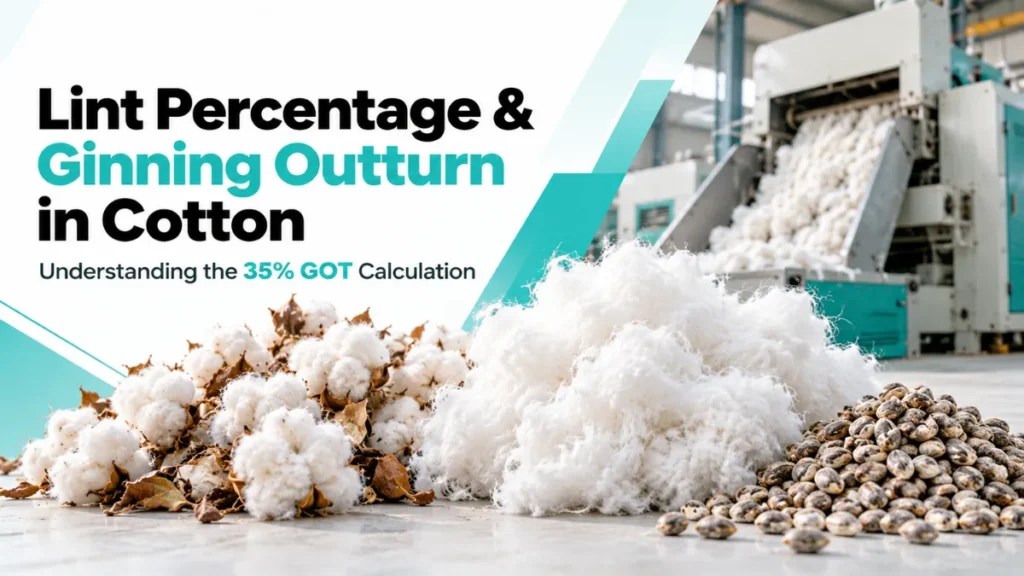
You drop 60 kg of kapas at the gin and get 21 kg of lint back. Is that good? Lint percentage and ginning outturn answer that question, and the math takes ten seconds. Below, you’ll get the formula, the Indian conversions, and the factors that push your number up or down.
Quick answer: Lint percentage and ginning outturn (GOT) describe one ratio. Divide the lint you recover by the kapas you started with, then multiply by 100. Take 21 kg of lint from 60 kg of kapas and you land on 35%. Most Indian hirsutum hybrids finish somewhere between roughly 33% and 37%.
What Do Lint Percentage and Ginning Outturn Mean?
Kapas is cotton straight from the boll, with the fibre still on the seed. A gin pulls that fibre off. The fibre becomes lint, and the seed keeps a thin coat of short fuzz. Our guide to the difference between lint and fuzz in cotton shows how the two compare.
Lint percentage tells you what share of the kapas turned into lint. People also call it ginning percentage, gin turnout or lint turnout. A higher number means more fibre from every quintal, so growers, ginners and breeders all track it.
Lint Percentage vs Ginning Outturn: Is There a Difference?
No, the maths is identical. Still, writers tend to use the two terms in different places. This table shows how sources usually use them. It’s a habit, not a formal rule.
| Lint percentage | Ginning outturn | |
| Where you meet it | Breeding trials and lab tests | Gins and the trade |
| Usual sample | A small, hand-ginned sample | A full lot or gin run |
| What moves the figure | Tidier test conditions | Moisture, trash and gin settings |
A hand gin and a factory gin rarely return the same figure, even on the same lot. Machines leave a little lint on the seed, and moisture and trash shift the weights.
The GOT Formula, With Indian Conversions
GOT (%) = (lint weight ÷ kapas weight) × 100
Example: 21 ÷ 60 × 100 = 35%.
Next, the units you’ll hear at a gin or a mandi:
- Quintal: 100 kg of kapas.
- Bale: 170 kg of lint. At 35% GOT, you need about 486 kg of kapas per bale (170 ÷ 0.35).
- Candy: 356 kg of lint. At 35% GOT, you need about 1,017 kg of kapas per candy.
What Is Inside a Bag of Kapas?
Many people think seed equals kapas minus lint. That skips two things: trash and moisture. A CottonInfo fact sheet from Australia gives a case with 40% lint, 50% seed and 10% trash.
At Indian GOT levels, even more of the bag stays non-lint. At 35%, 65 kg of every 100 kg is seed, trash and moisture. Divide 65 by 35 and you get about 1.9 kg of non-lint material for each kilo of lint. And the lint itself? Each fibre is a single cell, which you can see in our cotton fibre cross section.
How to Calculate Lint Percentage in Seed Cotton
You don’t need a factory to test a lot. Follow these steps:
- First, mix small handfuls of kapas from the top, middle and bottom of the heap until you have about 500 g.
- Next, weigh the sample.
- Then gin it with a small laboratory or hand gin until no lint stays on the seed.
- Weigh the lint.
- Divide the lint weight by the kapas weight and multiply by 100.
Repeat the test three times and average the results, because one sample can mislead you. ICAR-CIRCOT follows the same logic in its standard ginning percentage protocol, which also works with a portable gin.
Lint per acre (illustrative): Lint per acre equals kapas per acre times GOT. Say your field gives 12 quintals of kapas per acre at 34% GOT. That’s 12 × 0.34 = 4.08 quintals of lint. Each extra point of GOT adds about 12 kg of lint per acre, so on 20 acres a single point is worth 240 kg of lint. CICR runs the same sum per hectare: at 25 quintals of kapas, every extra 1% of GOT adds 25 kg of lint.
Is Your GOT Good?
Use this table as a rule of thumb. It comes from published trial ranges, not from a grading standard.
| Your GOT | How to read it |
| Below 33% | Low end of reported trial results. Check the variety, the moisture and your weighing. |
| 33% to 37% | Typical for Bt hirsutum hybrids in Indian trials. |
| Above 37% | High. Breeders aim for about 40%. Check the lint index before you celebrate. |
One warning: GOT tells you how much lint you get, not how good that lint is. For length, strength and micronaire, read our guide to cotton fibre quality parameters.
Lint Index and Seed Index: The Number GOT Hides
GOT depends on both lint weight and seed weight. So a variety with big seeds can show a modest GOT and still carry plenty of fibre per seed. Lint index fixes that. It tells you how many grams of lint 100 seeds carry, and seed index is simply the weight of 100 ginned seeds.
Lint index (g) = (seed index × GOT) ÷ (100 − GOT)
Illustrative example:
- Variety A: GOT 38%, seed index 8 g. Lint index = (8 × 38) ÷ 62 = 4.9 g.
- Variety B: GOT 35%, seed index 10 g. Lint index = (10 × 35) ÷ 65 = 5.4 g.
Variety A wins on GOT. Variety B carries more lint on every seed. So compare both numbers before you pick a variety.
What GOT Looks Like in India
Trials give ranges, not one number:
- 22 Bt hybrids tested in three environments gave GOT between 32.9% and 36.9%.
- A wider test of intra-hirsutum hybrids gave 28.2% to 39.2%.
- In north India, trials of desi (arboreum) lines report roughly 30% to 37%.
- CICR notes that breeders aim for about 40%.
So “about 35%” works as a rule of thumb. Your own figure will depend on the variety, the season and how you handle the lot. North India’s trials cover both hirsutum hybrids and desi lines, so ask which one a number refers to before you compare.
What Changes Ginning Outturn?
| Level | Factor | Effect | Can you control it? |
| Genetic | Variety or hybrid | Sets the base GOT | Yes, when you choose seed |
| Genetic | Seed size | Bigger seeds lower GOT | Through variety choice |
| Field | Boll maturity and picking time | Well-filled, fully opened bolls carry more lint | Partly |
| Field | Weather and pest damage | Change how the fibre develops | Partly |
| Gin | Moisture | Extra water adds weight to the kapas and drags GOT down. Cotton gins best at about 6% to 7% moisture | Yes |
| Gin | Trash | More trash means harder cleaning, and that can strip out good fibre | Yes |
| Gin | Machine and settings | Change how cleanly the fibre separates | Yes |
Handling moves the number even when the variety stays the same, so compare two lots only when you measured both the same way.
Want to protect your GOT? Do these four things:
- First, choose a variety with a known GOT before you sow.
- Next, pick fully opened bolls.
- Then keep the kapas dry and clean, because morning dew and damp bags add water.
- Finally, ask your gin to note the moisture next to the outturn.
Why GOT Matters, and Where Linters Come In
GOT decides how much lint you get from each quintal, so it affects what you earn and what a ginner can promise. But the story doesn’t end at the gin. The seed that comes out still wears a coat of fuzz. A later step, delinting, removes that fuzz, and the short fibre becomes cotton linters. That’s where our work at Moirai starts.
FAQs
What is the ginning percentage?
It’s the share of lint in the kapas weight: lint ÷ kapas × 100. It’s another name for GOT.
What is the lint percentage in cotton?
Many Indian hirsutum hybrids sit near 35%, and trials mostly report 33% to 37%.
What is the ratio of cotton seed to lint?
At 35% GOT, 100 kg of kapas gives about 35 kg of lint and 65 kg of seed, trash and moisture. That’s about 1.9 kg of non-lint material for each kilo of lint.
What is the lint of cotton?
Lint is the cotton fibre a gin pulls off the seed. Mills buy it by the bale.
How do I work out lint per acre?
Multiply your kapas yield per acre by your GOT. For example, 8 quintals at 35% gives 2.8 quintals of lint.

