
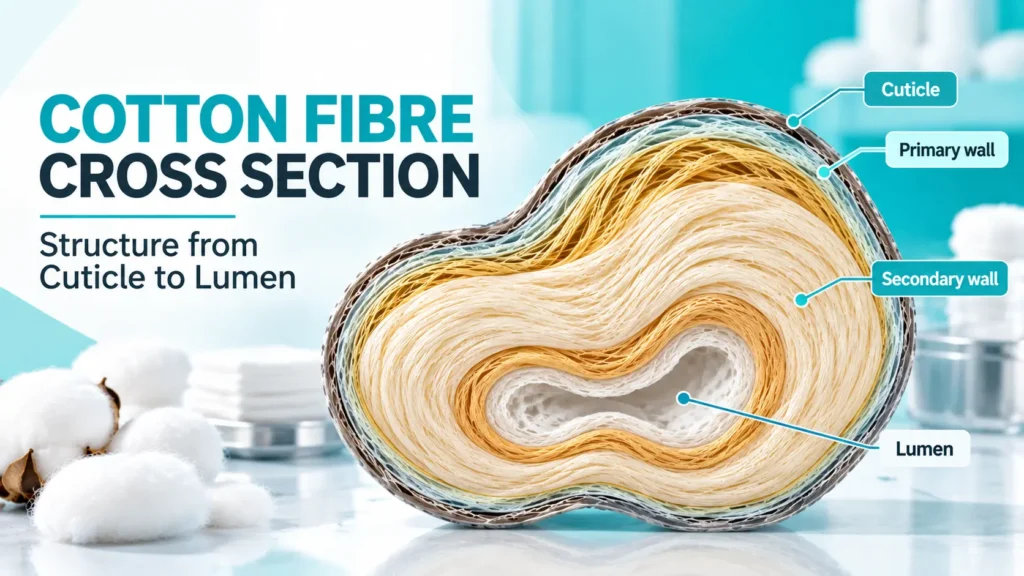
Quick answer: A cotton fibre has a kidney-shaped (bean-shaped) cross section. From the outside in, it has a waxy cuticle, a thin primary wall, a thick cellulose secondary wall and a hollow centre called the lumen. A mature fibre has a thick wall and a small lumen. An immature fibre has a thin wall and a large lumen. Mercerising turns the shape round.
Cotton looks simple, but one fibre is a tiny, layered plant cell. Under a microscope, its cross section tells you how mature the fibre is, how it will absorb water and how it will behave in yarn. If you want the basics first, start with what kind of fibre cotton is. Here, we look inside.
What does the cross section of cotton fibre look like?
A growing cotton fibre is a round, fluid-filled tube. When the boll opens in the field, the fibre dries in the sun and the tube collapses. In a north Indian cotton field, that happens each autumn. The Cotton Physiology chapter on fibre structure describes this drying step in detail.
The collapsed tube gives the classic kidney-bean cross section. The shape ranges from nearly round in mature fibres to flat in immature ones. The fibre also turns round again when it takes in water, which helps explain why cotton absorbs so well.
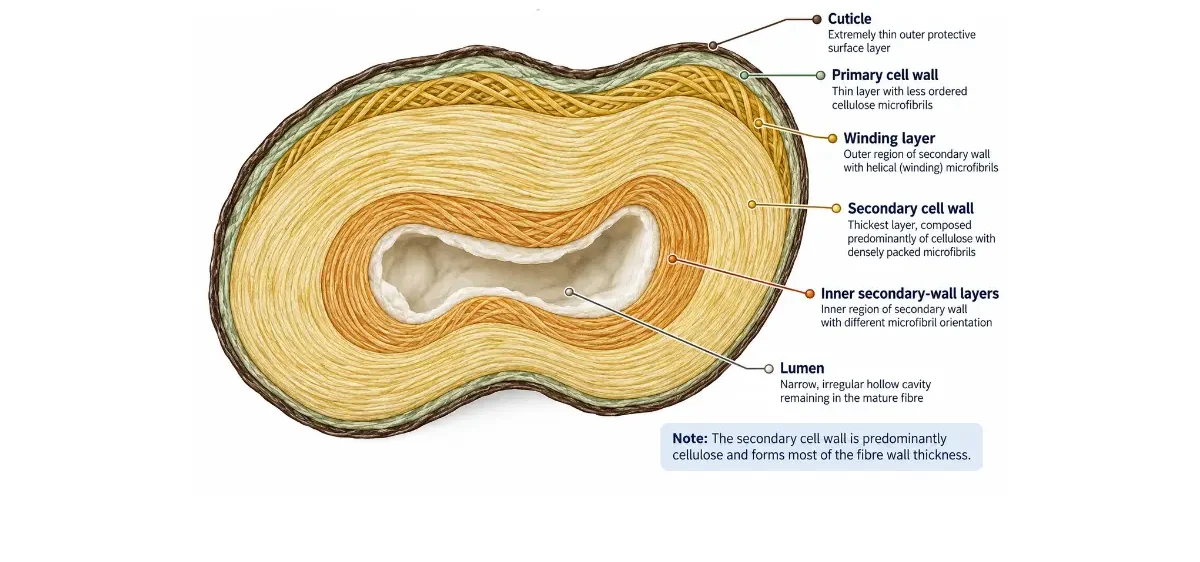
Because every boll holds a mix of fibres, a single sample usually shows several shapes side by side. Some are thick-walled and plump, while others are thin and flat.
Layers of cotton fibre: the microscopic structure from outside to inside
Each fibre is a single plant cell, a hair that grows from the cotton seed. Its wall has layers, and most textbooks describe four main ones.
| Layer | What it is | Why it matters |
| Cuticle | A waxy film a few molecules thick, with pectin and protein | Makes raw cotton resist water |
| Primary wall | The original thin wall, about 0.2 to 1 µm thick | Lets the fibre stretch as it grows |
| Winding layer | The first layer of the secondary wall, with fibrils wound at a different angle | Some sources list it separately |
| Secondary wall | The bulk of the fibre, nearly pure cellulose in concentric layers | Gives strength, with fibrils spiralling at about 20 to 45° |
| Lumen | The hollow canal down the centre | Large in immature fibres, small in mature ones |
Some sources count four layers, while others count five or six. The difference lies only in how they list things. The four-layer version skips the winding layer, and the six-layer version also lists the innermost layer of the secondary wall (the lumen wall) separately. For a deeper read, see this ScienceDirect overview of cotton fibre.
Longitudinal view of cotton fibre
Seen from the side, a cotton fibre looks like a flat, twisted ribbon. These twists are called convolutions, and they change direction along the fibre. The direction changes where the cellulose fibrils in the secondary wall reverse their spiral. Mature fibres also have more convolutions than immature ones.
Sources disagree on how many twists there are. Many textbooks give 40 to 65 per cm, while Cotton Incorporated gives 150 to 400 per inch, which is about 60 to 160 per cm. Counts vary with variety and maturity, so treat them as ranges.
The twists do real work. They help fibres grip each other, so spun yarn holds together well.
Mature, immature, dead and mercerised cotton compared
Not every fibre in a boll develops fully. The table shows how the main types differ.
| Type | Cross section | Wall and lumen | Side view |
| Mature | Kidney-shaped to nearly round | Thick wall, small lumen | Twisted ribbon, many convolutions |
| Immature | Flatter or U-shaped | Thin wall, large lumen | Flat ribbon, fewer convolutions |
| Dead | Collapsed and thin | Very thin wall | Almost transparent |
| Mercerised | Round to oval | Lumen nearly gone | Smooth and cylindrical, few convolutions |
Immature fibres cause trouble in processing, which is why mills care about maturity. Mercerising, meanwhile, treats cotton with strong caustic soda. The fibre swells, rounds out and becomes smoother and more regular. Its crystal structure also changes from cellulose I to cellulose II.
What is cotton fiber made of?
A typical cotton fibre is mostly cellulose, with small amounts of wax, pectin, protein and salts.
| Component | Typical share | Mainly found in |
| Cellulose | 86.8% | Secondary wall |
| Oils and waxes | 0.7% | Cuticle |
| Pectin | 1% | Primary wall |
| Carbohydrates | 0.5% | Primary wall |
| Proteins | 1.2% | Lumen |
| Salts | 1% | Lumen |
| Water | 6.8% | Throughout |
| Others | 2% | Throughout |
That 86.8% includes about 6.8% water. On a dry basis, cellulose comes to about 93%, which likely explains why other sources quote 90% or more. Scouring and bleaching then strip out most of the rest.
How the structure explains cotton fibre properties
Structure decides how cotton behaves. The table links each feature to a property. For the measured side of those properties, such as length, strength and micronaire, see our guide to cotton fibre quality parameters.
| Structural feature | What it does |
| Secondary wall of cellulose with spiralling fibrils | Gives strength and some stretch |
| Convolutions | Help fibres grip each other in yarn |
| Porous wall and lumen | Let liquids and vapours in, so cotton absorbs water |
| Waxy cuticle | Makes raw cotton resist water |
| Thick or thin wall | Mature fibres process better than immature ones |
The cuticle also explains absorbent cotton. Scouring removes it, and bleaching cleans the fibre, so the cellulose can take up water straight away. That’s why a pack of absorbent cotton wool soaks up liquid, while raw cotton from the field doesn’t. Our guide to surgical cotton shows how this carries into medical products.
How labs look at the cross section of cotton fibre
Labs embed fibres in resin, cut thin cross sections and photograph them under a microscope. Published micrographs of cotton cross sections use magnifications of about 2,500×. Analysts then compare the area of the fibre wall with the size of the fibre outline to judge maturity. Micronaire also reflects maturity, but it blends fineness and maturity into one number, so the same reading can hide very different fibres. A cross section shows what the number can’t.
FAQ
What is the cross-sectional structure of cotton fiber?
A kidney-shaped outline with a waxy cuticle, a thin primary wall, a thick cellulose secondary wall and a hollow lumen at the centre.
What is the structure of cotton fiber?
A single plant cell shaped like a twisted ribbon, with four main layers from the cuticle to the lumen.
What is cotton fiber made of?
Mostly cellulose, about 87% of its fresh weight and about 93% of its dry weight. The rest is wax, pectin, protein, salts and water.
Why is cotton fibre kidney-shaped in cross section?
The round tube collapses as the fibre dries after the boll opens.
What does mercerisation do to cotton?
It swells the fibre into a rounder, smoother shape with a nearly closed lumen.

