
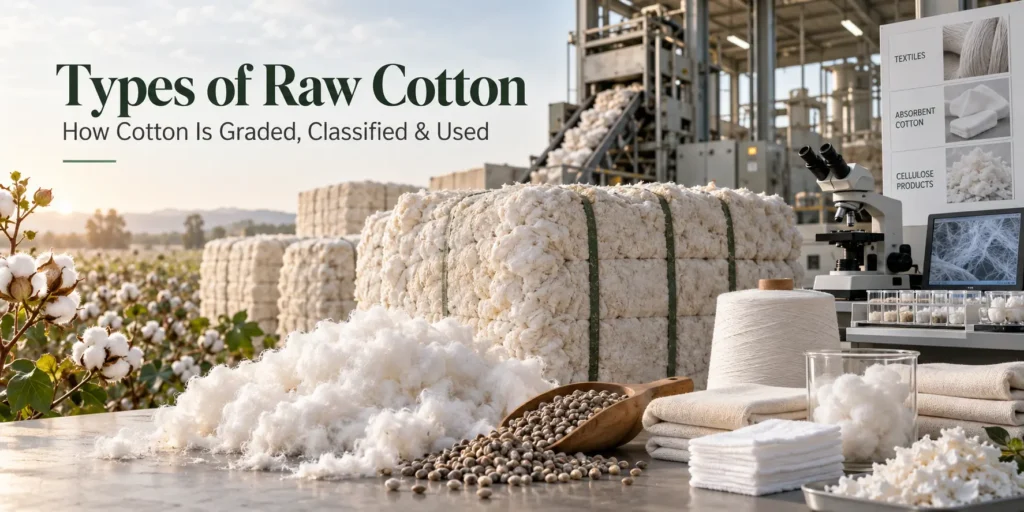
Search “types of cotton” and most of what comes up is fashion content: Pima, Egyptian, jersey, twill. Fine if you’re buying a shirt. It’s less useful if you’re trying to understand what happens before that fabric even exists. There’s a whole grading system between the field and the loom that almost nobody writes about.
That system decides which bale becomes a luxury shirt and which becomes an everyday T-shirt. Some bales never touch a loom at all, because they’re headed for a hospital dressing or a pharmaceutical tablet instead. This guide covers that side of cotton plainly: what raw cotton actually is, how graders classify it, what India grows, and cotton linters. Almost no “types of cotton” guide even mentions that last one, and it’s the raw material behind cotton wool, surgical cotton, and cellulose products.
Quick answer: Graders classify raw cotton by staple length (short to extra-long), micronaire, strength, and trash content, not by variety name. Separately, they grade cotton linters (the short fiber left on the cottonseed after ginning) by cut, for use in absorbent cotton and cellulose products rather than yarn. There’s no single “best” type; it depends on whether the end product is a fabric, an everyday textile, or a medical/industrial product.
What Is Cotton, Exactly?
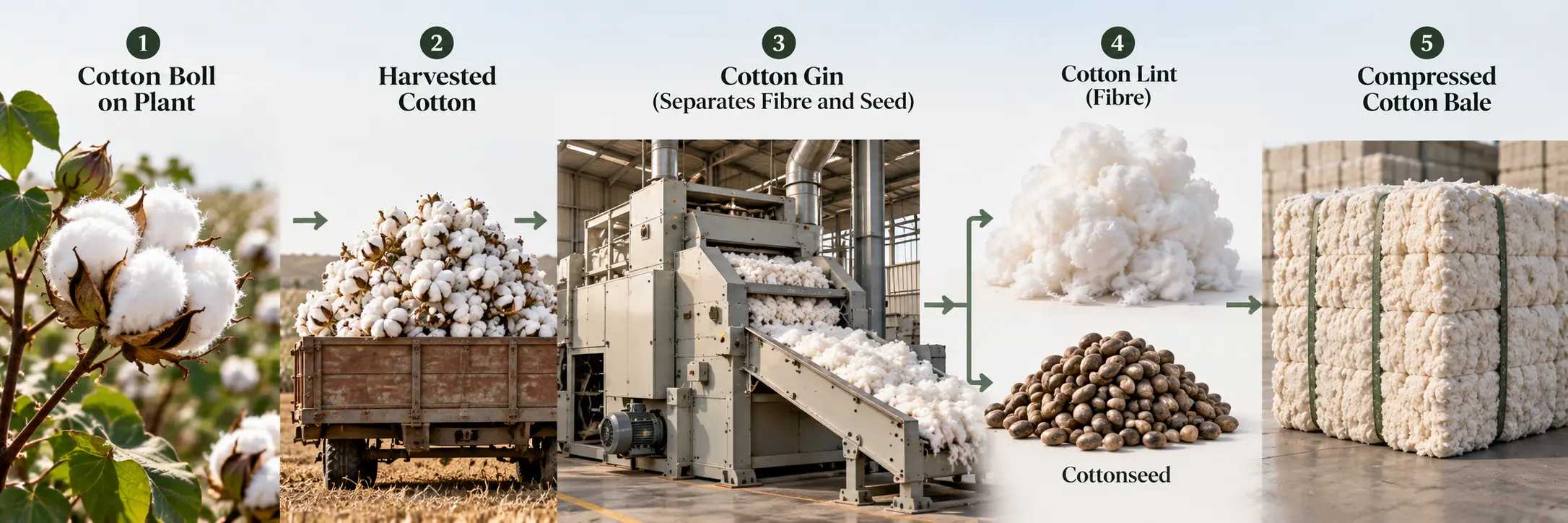
Ginning separates raw cotton fiber from the cottonseed, before spinning turns it into yarn. Mills and traders buy and sell cotton in this exact form. When you read about a cotton “bale” in a trade report, that’s raw cotton, not fabric.
Ginning splits every cotton boll into two products, and most guides only ever cover half of that split:
- Lint (also called staple cotton): the longer fibers, spun into yarn for textiles.
- Cotton linters: the short, fuzzy fibers left clinging to the cottonseed after ginning. Spinners never turn these into yarn. Instead, they become the raw material for absorbent cotton, surgical cotton, and cellulose products. If you’re buying linters directly, what to check before ordering a bale is worth reading alongside this section.
Most “types of cotton” content stops at the first bullet.
How Raw Cotton Is Graded
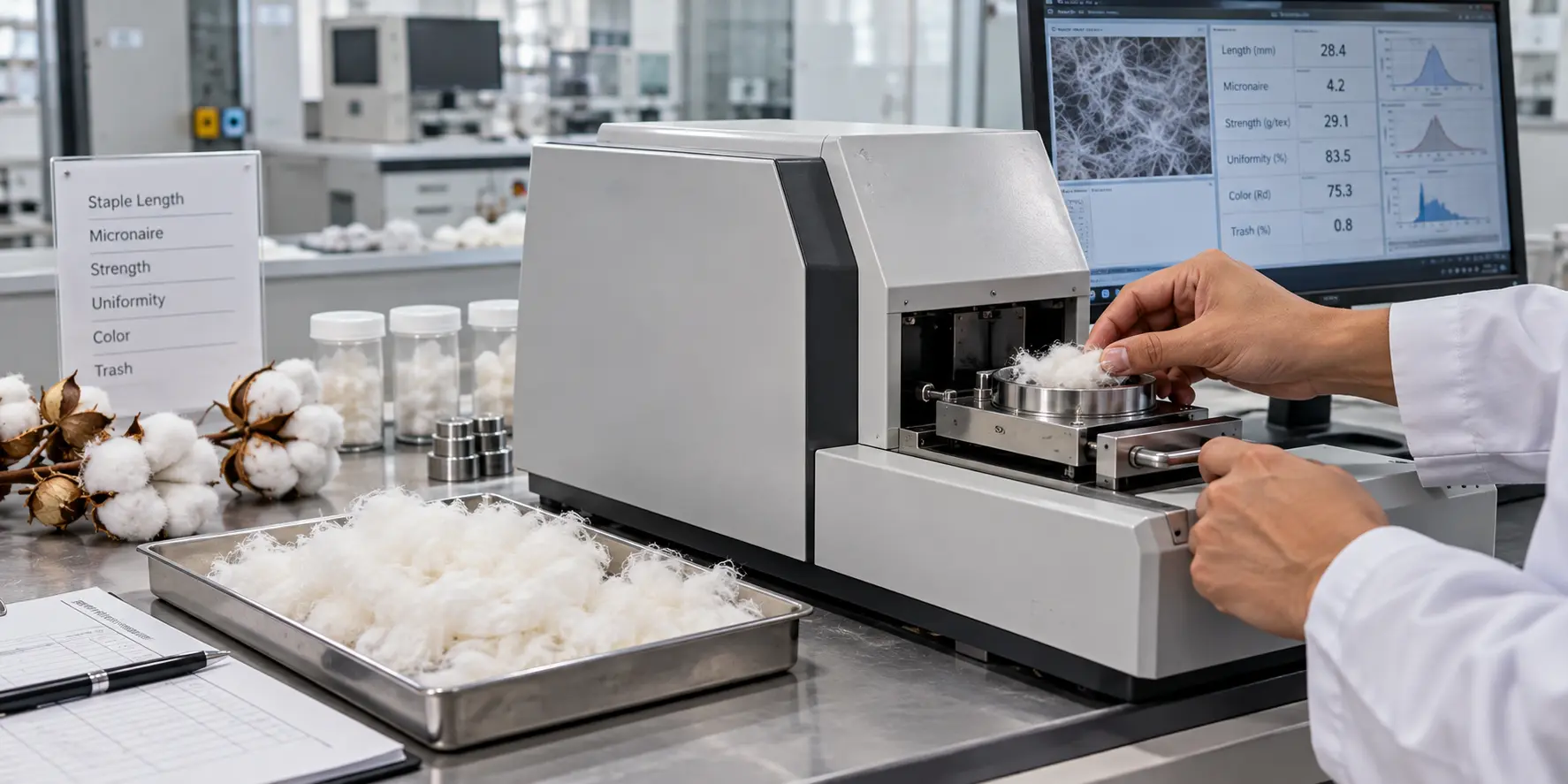
Traders don’t classify raw cotton by variety name. They measure it. In India, cotton classing labs often work through the Cotton Corporation of India and private testing labs. They use an instrument called HVI (High Volume Instrument) to test bale samples against several properties.
| Property | What it means in plain terms |
|---|---|
| Staple length | How long an individual fiber is, the single biggest factor in fiber quality |
| Micronaire | A number (usually 2 to 6) showing fiber fineness and maturity. Around 3.8 to 4.6 is considered an average, well-developed fiber; below that is finer, above it is coarser |
| Strength | How much force a bundle of fibers can take before breaking, tested in grams per tex |
| Uniformity index | How consistent the fiber lengths are within one sample; higher is better and more predictable to spin |
| Color grade & trash content | How bright the lint is, and how much leaf or plant debris remains after ginning |
| Moisture | Affects weight and how the fiber behaves during processing |
None of this has anything to do with brand names. It’s simply the language mills, exporters, and industrial buyers use to describe a bale before deciding what it’s suited for.
Types of Cotton by Staple Length
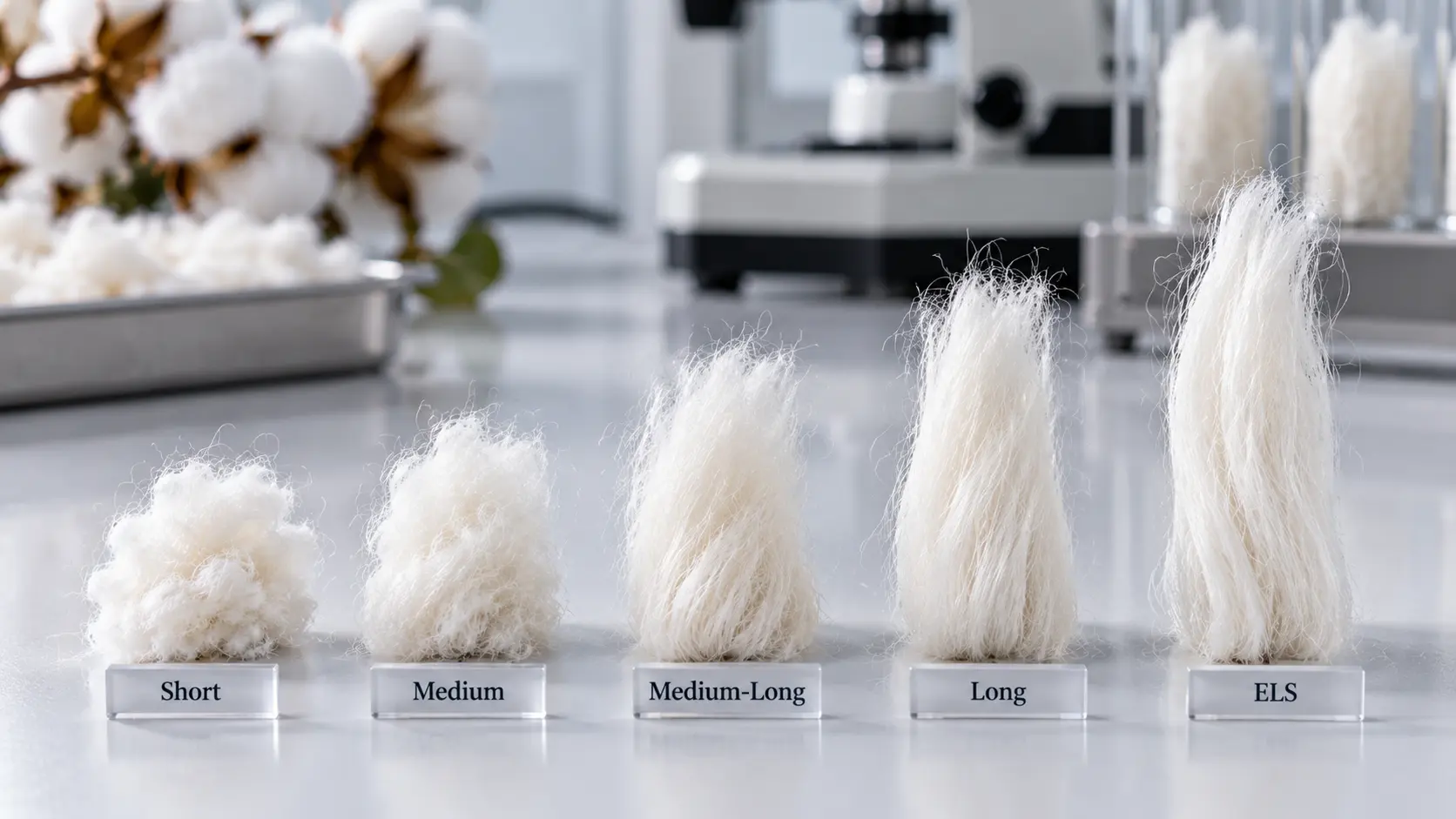
Staple length drives almost every downstream decision, which is why it has its own classification system:
| Staple category | Fiber length | Typical use |
|---|---|---|
| Short staple | Under 20.5 mm | Coarse yarns, absorbent/industrial cotton, cotton linters |
| Medium staple | 20.5 to 24.5 mm | Everyday clothing, mid-range fabrics |
| Medium-long staple | 25.0 to 27.0 mm | Shirting, general apparel |
| Long staple | 27.5 to 32.0 mm | Fine shirting, bedding, quality yarns |
| Extra-long staple (ELS) | 32.5 mm and above | Premium fabrics, fine-count yarns |
Types of Raw Cotton Grown in India
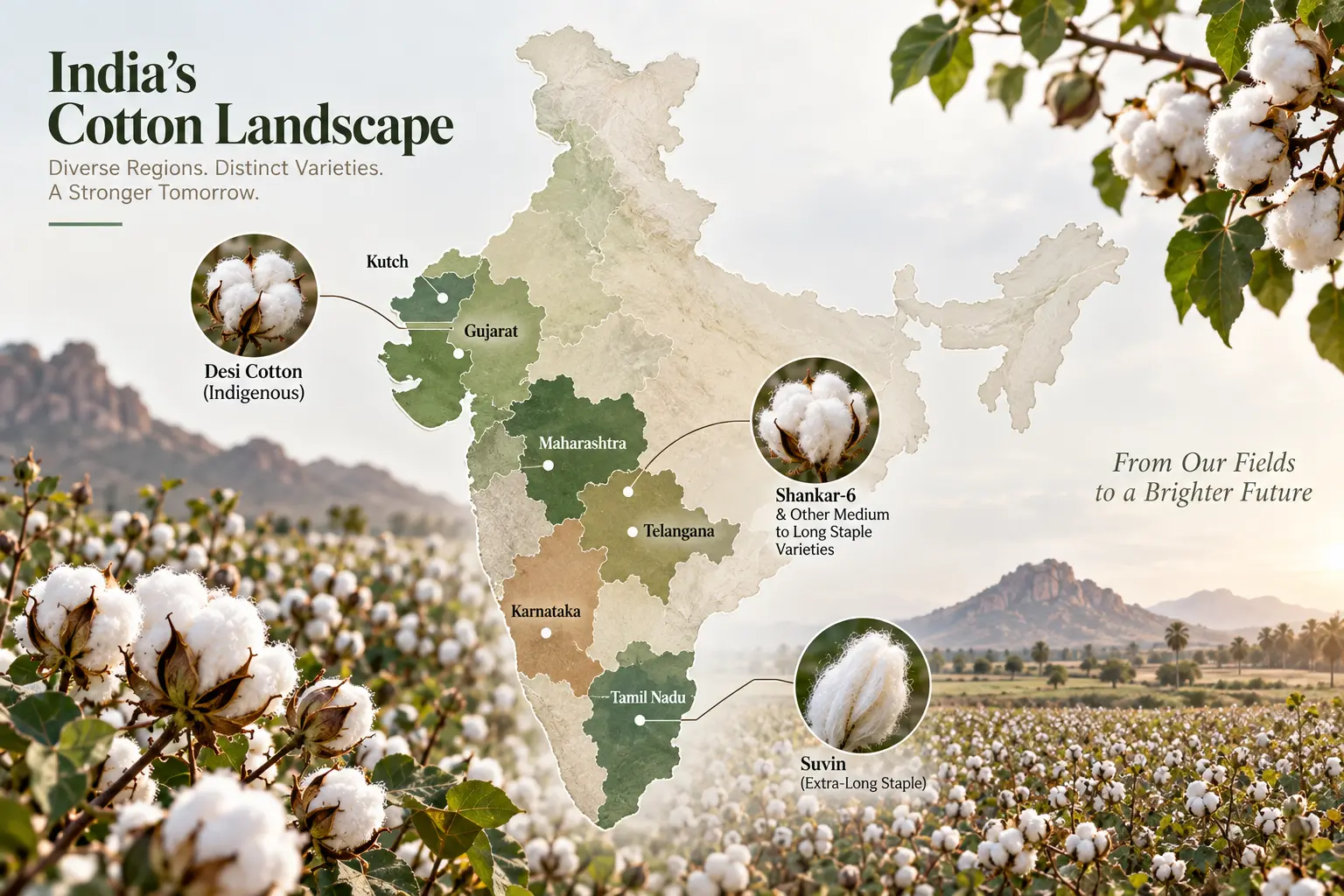
India grows all four cultivated cotton species. That’s the only reason its raw cotton covers the entire staple range above. Most countries specialize in one or two.
Desi (indigenous) cotton. Bred from the native species Gossypium arboreum and Gossypium herbaceum, Desi cotton is short-staple. It’s also genuinely drought-tolerant, not just marketed that way. Kala cotton, grown rain-fed in Kutch, Gujarat, is the best-known Desi variety. It’s one of the only commercial cottons still grown with almost no synthetic inputs.
Medium-to-long staple hybrids. This is the backbone of the whole domestic market. Shankar-6, grown across Gujarat, is India’s most commercially traded cotton and the benchmark grade in domestic trading. When a trader quotes “Shankar-6 price,” that’s effectively the reference point everyone else prices against. Bunny, H-4, J-34, and LRA-5166 sit in similar medium-to-long bands, grown across Gujarat, Maharashtra, Telangana, and Tamil Nadu.
Extra-long staple varieties. MCU-5 and DCH-32, grown mainly in Tamil Nadu and Karnataka, sit at the long and extra-long end. Suvin, bred from Egyptian and Sea Island parentage, is India’s answer to Pima cotton. Mills reserve it for the country’s finest yarns rather than general trade.
Bt cotton hybrids. This isn’t a staple classification at all; it’s a pest-resistance trait. Breeders have bred Bt varieties (Bollgard I and II) into most of India’s commercial cotton acreage today. They layer this trait onto whichever staple-length variety a farmer already grows.
The 4 Types of Long Staple Cotton
Four raw cotton varieties set the benchmark for long and extra-long staple quality worldwide:
- Egyptian cotton: grown along the Nile Valley; historically the reference point for luxury textiles.
- Pima cotton: grown in the US Southwest and Peru; growers brand certified US-grown Pima as Supima.
- Sea Island cotton: the rarest, grown in small quantities in the Caribbean.
- Suvin cotton: India’s extra-long staple variety, bred to compete with Egyptian and Sea Island quality under Indian growing conditions.
All four come from the species Gossypium barbadense. That’s what gives them their exceptional length and strength compared to standard Upland cotton.
Cotton Linters: The Type of Raw Cotton Most Guides Skip
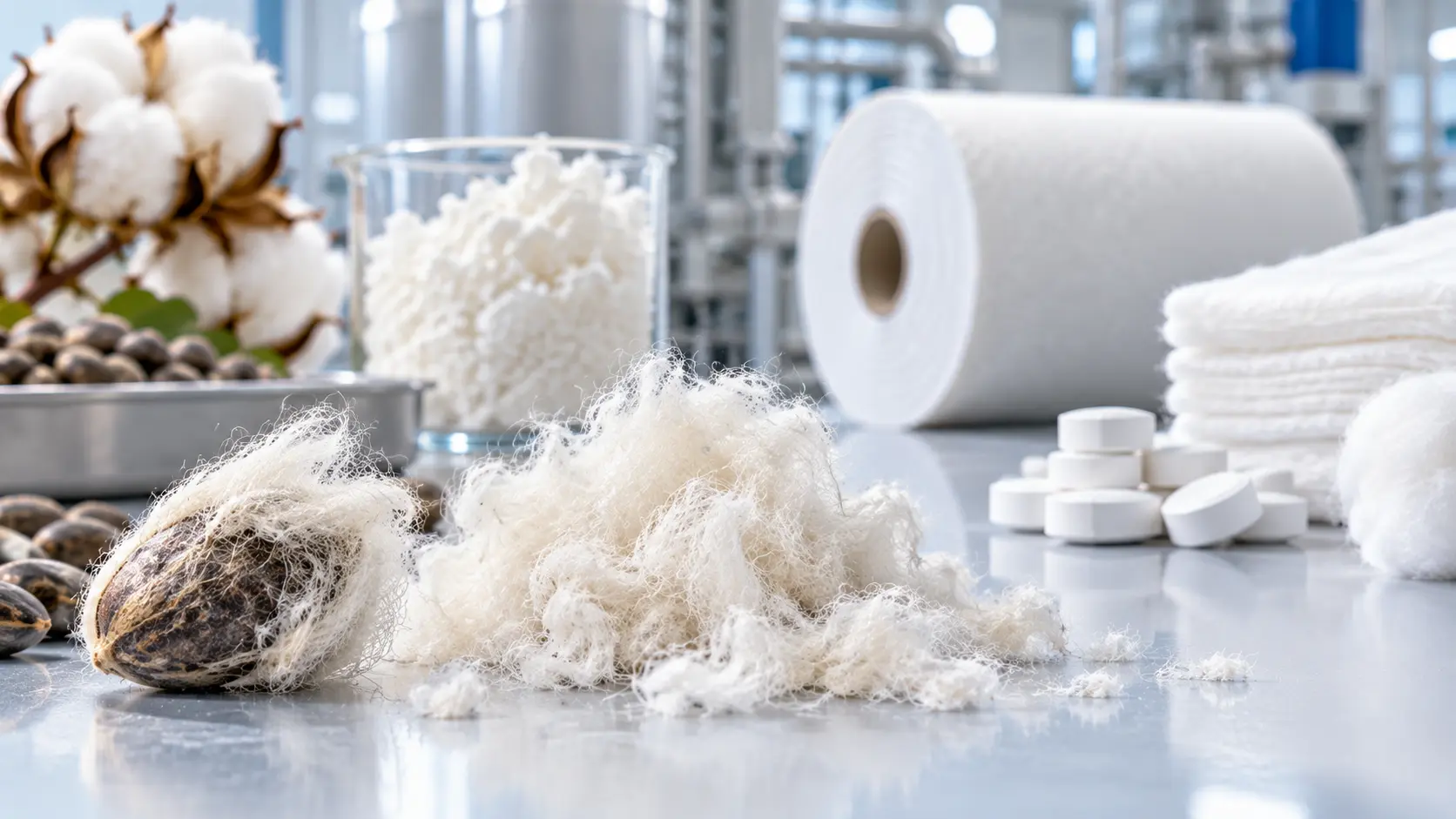
This is where raw cotton stops being about fabric at all. Cotton linters are the short fibers left on the cottonseed after ginning removes the main lint. Graders classify them by how many times workers have cut them from the seed: first, second, or third. Each cut heads toward a different use.
Linters by Cut
- First-cut linters: the cleanest cut, with the least non-cellulosic impurity. Goes into medical and cosmetic applications, plus upholstery and mattress filling.
- Second-cut linters: mainly become purified cotton linter pulp, also called chemical cotton, refined to roughly 98% or higher alpha-cellulose.
- Third-cut linters: carries the most impurity of the three, so it goes toward lower-grade industrial applications.
- Mill runs: a blend of first- and second-cut linters, roughly 1:4 by weight, that also goes into medical and cosmetic products.
From Linters to Cellulose Products
Purified linters become dissolving pulp, the base material for rayon, cellulose acetate, and other cellulose derivatives. That includes paper and packaging applications that most people never trace back to raw cotton. Linters are also the dominant raw material for microcrystalline cellulose (MCC). That’s the pharmaceutical-grade cellulose manufacturers use as a binder and filler in tablets. More than 85% of the world’s pharmaceutical-grade cellulose comes from cotton linters. One kilogram of linter-derived cellulose makes somewhere between 7,500 and 9,000 standard tablets. A closer look at what linters pulp actually is goes deeper on this.
Comber noil belongs in this conversation too. Spinning mills generate this short-fiber waste during combing, and it’s another key raw material for absorbent and surgical cotton. Manufacturers prefer a high-micronaire, non-spinnable fiber like this over long-staple lint for that use. India’s absorbent/surgical cotton demand runs to roughly 2 million bales a year. For a category that large, it gets remarkably little coverage.
This is the raw material Moirai works with directly. Moirai turns raw cotton and linters into cotton linter pulp and bleached surgical cotton for industrial, institutional, and medical buyers.
What Type of Cotton Is 100% Cotton?
A “100% cotton” label only confirms the absence of synthetic or blended fiber. It says nothing about species, staple length, or grade. Unless the label names a specific variety, it’s almost always standard Upland cotton. Upland accounts for roughly 90% of global raw cotton production.
Which Type of Raw Cotton Is Best?
There’s no single best type. It comes down to what the raw cotton needs to become.
- For luxury fabrics and bedding: extra-long staple cotton (Egyptian, Pima, Suvin) wins on length, strength, and softness.
- For everyday, affordable textiles: medium-to-long staple Upland hybrids like Shankar-6 offer the best balance of cost and quality.
- For absorbent and surgical cotton: manufacturers prefer short-staple, high-micronaire raw cotton and comber noil, since absorbency and purity matter more than fiber length here. If you’re deciding between the two finished products, absorbent cotton vs. bleached surgical cotton breaks down the practical differences.
- For cellulose derivatives (MCC, dissolving pulp, chemical cotton): first- and second-cut cotton linters are the raw material of choice; processors grade them on alpha-cellulose content rather than staple length at all.
Buying in volume rather than sourcing raw material yourself? How absorbent and non-absorbent cotton differ and our full product range cover the buyer’s side of this same classification.
Key Takeaways
- Raw cotton is fiber after ginning, before spinning; graders classify it by staple length, micronaire, strength, and trash content, not by brand name.
- Ginning splits every cotton boll into lint (for yarn) and cotton linters (for absorbent cotton and cellulose products); most guides only ever cover the first.
- India grows all four cultivated cotton species, from short-staple Desi cotton to extra-long staple Suvin.
- Egyptian, Pima, Sea Island, and Suvin are the four recognized long/extra-long staple varieties.
- “100% cotton” states fiber content, not variety or grade.
- Graders classify cotton linters by cut (first, second, third); linters are the raw material behind chemical cotton, dissolving pulp, and over 85% of the world’s pharmaceutical-grade cellulose.
Frequently Asked Questions
What are the types of raw cotton?
Graders classify raw cotton by staple length, micronaire, strength, uniformity, and color/trash content. Separately, they grade cotton linters, the short fiber left on the cottonseed after ginning, by cut (first, second, third) for use in absorbent cotton and cellulose products rather than yarn.
How many types of cotton are there?
There are four cultivated cotton species worldwide: Upland, extra-long staple (Barbadense), and two Desi species. Breeders have developed dozens of commercial varieties from them, and India alone recognizes more than 25.
Which type of cotton is best?
It depends entirely on the end use. Extra-long staple suits luxury textiles, medium-long staple suits everyday fabric, and short-staple cotton or cotton linters suit absorbent, surgical, and cellulose-based products.
What are the different types of cotton in India?
India grows Desi (indigenous) cotton, medium-to-long staple hybrids like Shankar-6, and extra-long staple varieties like Suvin and DCH-32. Breeders also layer Bt cotton hybrids across all of the above.
What are the 4 types of long staple cotton?
Egyptian, Pima, Sea Island, and India’s own Suvin cotton, all bred from Gossypium barbadense.
What type of cotton is 100% cotton?
It confirms there’s no fiber blend, not which variety was used. Unless stated otherwise, it’s almost always standard Upland cotton.
People talk about raw cotton like it’s one commodity with a few famous names attached: Egyptian, Pima, not much else. It isn’t. It’s a graded system with a fabric side and an industrial side, and writers rarely cover the two together. If you’re sourcing the industrial side, see how it’s made or browse our full product range.
Also you can visit our factory unit

