
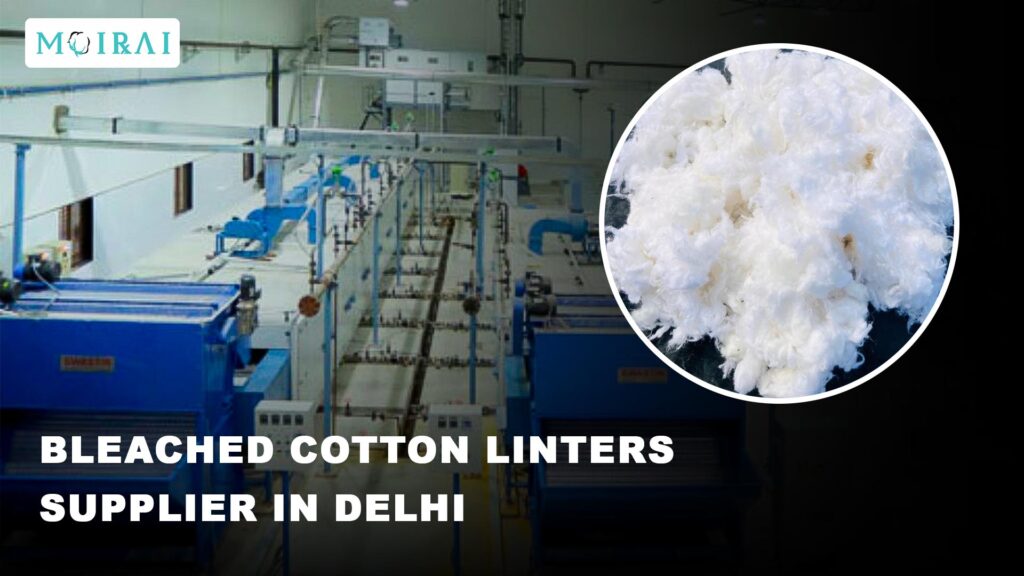
Quick answer: A dependable bleached cotton linters supplier in Delhi-NCR should hand over verifiable specifications: alpha cellulose content, viscosity, moisture, and ash figures, not just sustainability talk. They should also carry a third-party quality certification like ISO 13485:2016 and deliver consistent batch-to-batch performance. Moirai manufactures Grade I cotton linter pulp in Hisar, Haryana, about 170 km from Delhi. We supply pharmaceutical, specialty chemical, and paper manufacturers across the Delhi-NCR region.
Delhi-NCR has grown into a major manufacturing hub for cellulose-dependent industries. Pharmaceuticals, specialty chemicals, paper, and packaging all lean on a steady supply of raw material. As sourcing standards tighten, manufacturers are paying closer attention to their raw material sources. They also care more about consistent performance, batch after batch.
Cotton linters are the short fibers left on cottonseed after ginning. Manufacturers value them for their high cellulose content and how many uses they cover. This post looks at what matters when picking a bleached cotton linters supplier in Delhi. It also covers where Moirai fits into that picture for buyers in the region.
Why Sourcing Quality Matters More Than Ever
Cotton linters come from a renewable raw material and break down naturally, which already puts them ahead of synthetic fibers on environmental impact. But the sourcing decision goes well past the raw material itself. A few things separate one supplier from another:
- Consistency of alpha cellulose content: the purity level that decides how well the pulp performs once it hits downstream processing
- Batch-to-batch viscosity control: critical for industries like nitrocellulose and specialty paper, where a shift in viscosity throws off production
- Processing transparency: whether a supplier can walk you through their degreasing and bleaching process instead of just calling it “eco-friendly”
Cotton linter pulp feeds into a fairly broad set of downstream industries: nitrocellulose production, cellulose ethers like CMC (carboxymethyl cellulose), specialty and currency-grade papers, and viscose or rayon fiber manufacturing. Each of these end uses puts slightly different demands on alpha cellulose purity and viscosity, which is why batch consistency counts for more here than it might with a simpler raw material.
Raw Cotton Linters vs. Cotton Linter Pulp
These two terms get used interchangeably, but they’re not the same product. Raw cotton linters are the short fibers pulled straight off cottonseed after ginning, largely untouched. Manufacturers clean, degrease, bleach, and refine those linters into cotton linter pulp, the purified cellulose product with the specifications below. If you’re sourcing for an industrial cellulose application, you almost always need the processed pulp rather than the raw linters. Our Cotton Linter Pulp product page has the full specs and pricing.
What Moirai’s Bleached Cotton Linters Offer
Our Grade I cotton linter pulp carries these specifications:
| Property | Specification |
| Alpha cellulose content | 98.5% minimum |
| Moisture content | 7% |
| Ash content | 0.12% maximum |
| Iron content | 15 ppm maximum |
| Hydrophility (wetting time) | 2 seconds maximum |
| ISO brightness | 80 minimum |
| Degree of polymerization | 2080–2120 DP |
These numbers come straight from our own product spec sheet, not a general industry average. They’re also the figures that determine whether the pulp will behave consistently once it’s running through your own line.
A Certification Behind the Claims
Moirai’s manufacturing facility holds ISO 13485:2016 certification, the international quality management standard for medical device manufacturing. Its scope names cotton linter pulp directly, alongside our absorbent cotton wool and bleached cotton lines. A third-party auditor stands behind these specifications, not just our word. We also hold a valid Importer-Exporter Code (IEC) from India’s DGFT. This matters for buyers whose supply chains need a partner who can export.
How the Pulp Gets Made
We start by cleaning raw cotton linters to pull out seed fragments and debris. Next, the fiber goes into a cooking stage, where we boil it with an alkali solution, typically 10 to 15% caustic soda, along with steam, in digesters. This step gets the alpha cellulose purity up to the levels listed above. From there, we drain and wash the unbleached pulp, then dilute and refine it to adjust fiber length before bleaching. Bleaching usually runs in two or three separate steps, using agents such as hydrogen peroxide, sodium hypochlorite, or chlorine dioxide. We wash the pulp after each step and adjust the pH to spec. Finally, we screen, clean, and refine the bleached pulp to hit target viscosity and moisture numbers before pressing it into sheets or bales for shipment.
Supplying Delhi-NCR from Hisar
Moirai runs its manufacturing out of Hisar, Haryana, about 170 km from Delhi. That distance keeps logistics manageable for bulk shipments into Delhi-NCR’s industrial clusters. That includes Patparganj, Narela, Okhla, Noida, and Faridabad, without the extra transit time or cost of sourcing from farther away.
We supply cotton linter pulp regularly to pharmaceutical, specialty chemical, and paper manufacturers across Delhi-NCR, alongside buyers throughout the rest of India.
Questions Worth Asking a Cotton Linters Supplier
If you’re comparing suppliers for your own production line, push past general reassurance. Ask for specifics:
- What’s the guaranteed alpha cellulose percentage, and is it tested on every batch?
- What degree of polymerization range do you work within, and does it fit your process?
- What’s the actual moisture and ash content, and how much does it move from one shipment to the next?
- Where is the material made, and what does that distance mean for your delivery timeline?
A supplier who can answer these with numbers, rather than reassurance, is the one worth sticking with long-term.
Bulk Orders and Pricing
Cotton linter pulp moves in bulk, industrial-scale quantities, not small retail lots. Before you settle on a supplier, get clear on three things: minimum order quantity, per-kg pricing at your required volume, and a realistic delivery timeline. All three shift from supplier to supplier and hit your landed cost directly. Reach out through our website’s inquiry form or WhatsApp for current pricing and MOQ on Moirai’s Grade I cotton linter pulp.
Final Thoughts
Sourcing in Delhi-NCR’s cellulose-dependent industries comes down to one question: can the supplier back up what they’re saying? That means real specifications, a certified quality system, and a process they’re willing to explain, not sustainability language with nothing behind it. Moirai manufactures Grade I bleached cotton linter pulp under ISO 13485:2016 certification in Hisar. We supply it regularly across Delhi-NCR, built on numbers you can check.
Frequently Asked Questions
What is the difference between cotton linters and cotton linter pulp?
Raw cotton linters are the short, mostly untouched fibers pulled from cottonseed after ginning. Manufacturers clean, degrease, bleach, and refine those linters into cotton linter pulp. This purified cellulose product carries defined alpha cellulose, viscosity, and moisture specifications.
Is cotton linter pulp available for delivery in Delhi-NCR?
Yes. Moirai manufactures cotton linter pulp in Hisar, Haryana, about 170 km from Delhi. We supply pharmaceutical, specialty chemical, and paper manufacturers across Delhi-NCR industrial clusters, including Patparganj, Narela, Okhla, Noida, and Faridabad.
What certifications should a cotton linters supplier have?
Look for a third-party audited quality certification, such as ISO 13485:2016. Its scope should name cotton linter pulp directly rather than making a broad, generic company claim. Export-capable suppliers should also carry a valid Importer-Exporter Code (IEC).
What is the minimum order quantity for cotton linter pulp?
Cotton linter pulp moves in bulk, industrial-scale quantities rather than small retail lots. Minimum order quantity and pricing vary by supplier and volume, so contact Moirai directly for current MOQ and pricing on Grade I pulp.
Curious about the finished product side too? See our guide on Bleached Surgical Cotton for how surgical-grade cotton differs from raw linter pulp.
Sources & References
- Paper Mart. Cotton linters: a valuable raw material for paper industry. Technical Article, Paper Mart, a bi-monthly magazine for the pulp, paper, and converting industries in India.
- Moirai Cotton Pulp Private Limited, ISO 13485:2016 Certificate, Certificate No. 305024121401MD.

